2026 Archaeology Field Experience: Indigenous Archaeology on Hawai'i
This field experience is led by Archaeology Center professor Dr. Michael Wilcox and his colleague at Foothill College, Dr. Samuel Connell. Applications submitted by Friday, 3/27 at 9:00am PT will be given priority consideration.
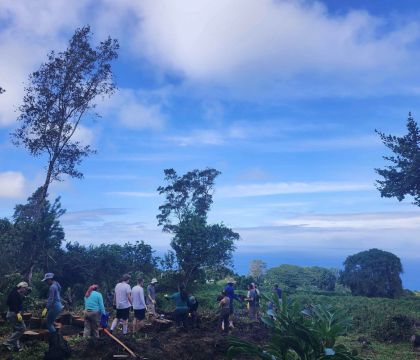
The Foothill Hawaii Program is an entry-level, intensive archaeological/anthropological field school and cultural immersion experience in Hawaii. The three week/7-day-week program weaves together, on a day-to-day basis, lectures, discussions, readings, fieldwork activities, excursions and hands-on practice & service learning in the fields of archaeology and applied cultural anthropology. Our program will be Community Based Participatory Research, working with local groups to help preserve and study the landscape, including the Kaloko Fishpond on the National Park Lands, a biological preserve in Hamakua, and taro fields in Waipio Valley in Kohala. Field learning is complemented by online instruction and assignments offered via the Canvas Learning Management System before and after the program as part of Foothill College’s summer quarter.
Trip Dates: July 18 - August 8
Participants must enroll in two summer courses at Foothill College that take place from early July to the end of August:
ANTH 12 Applied Anthropology (4 units)
ANTH 51 Archaeological Survey (2 units)
Upon completing the courses, students may request to transfer these credits to their Stanford degree.
Course Expectations
Success in this program requires consistent, active, and respectful participation in all activities, including fieldwork, lectures, and discussions. As guests in Hawaii and representatives of the program, students' behavior has a significant impact on the research team and future field schools. To help set expectations, we want to share a few things up front so that students can self-select thoughtfully:
- The days are long and the physical work is demanding — and that’s part of what makes the experience so meaningful.
- Students join as members of a larger community project, not as a separate Stanford cohort, and we find that spirit of shared purpose really enriches the program.
- Given our location and community context, food options are limited. Hawaiian cuisine is wonderful, but accommodating specialized dietary needs (such as soy-free diets) is generally not feasible.
In addition to full participation, students must complete various assignments such as:
- Participating in discussions (in the field and online)
- Recording appropriate notes in an archaeological and laboratory field log
- Recording appropriate field notes during ethnographic and applied fieldwork
- Completing a practical demonstration of key survey techniques
- Completing a practical demonstration of key laboratory techniques
- Completing assigned field exercises, short assignments and reflections
Beyond the core curriculum, students are encouraged to consider their personal impact through a "Legacy Project." This mentored project challenges participants to think about what positive contribution they can make to the host community and their own research journey. This opportunity, along with optional independent research projects, underscores the program's emphasis on not only academic learning but also on creating a meaningful and responsible engagement with the people and places of Hawaii.
Accommodations, dietary needs, and other individual travel details will be discussed at a later time if your application is accepted. Please contact the Student Services Officer, Kira Salazar, atksal@stanford.eduwith any questions, concerns, or information you would like to share.
- Archaeological Survey Methods, Data Recording, Photography, and Lab Analysis
- Exposure to Hawaiian Culture and Colonial and Imperial Processes
- Ethnographic and Anthropological Fieldwork Methods such as Mapping, Observation, and Interviews
- Raised Awareness of Ethics and Impact of Archaeological Research on Modern Communities
Eligibility
- This field experience opportunity is open to all undergraduates except graduating seniors.
- Undergraduates from all majors are encouraged to apply.
- No prior knowledge of archaeology is required, although we prefer to support students who will pursue an archaeology-centered career. All necessary training will be provided while in the field.
- Applicants will need an updated passport by the time of acceptance that does not expire within 1 year of the trip. This is very important.
- Acceptance to the Hawaii field experience comes with funding for eligible expenses subject to the budget of the project. Housing, daily meals, and materials used on-site will be fully covered by the project. The Archaeology Center will issue a stipend to students to purchase flights based on the real costs of flights to and from their field site. Students will be informed of the stipend limit prior to booking. Per university policy, the Archaeology Center does not pay for personal travel outside the dates or locations of field experiences.
- Students who plan to participate in an archaeology field experience cannot receive a major grant or a Chappell-Lougee scholarship within the same academic year as their field experience.
Requirements
- Pre-departure assignments: Students accepted to this field experience are required to enroll in two summer courses at Foothill College from early July to the end of August: ANTH 12 Applied Anthropology and ANTH 51 Archaeological Survey. They will complete assignments on Canvas before and after the course.
- SURPS application: Upon their return, the Archaeology Center requires that all field experience students apply to SURPS (Symposia for Undergraduate Research and Public Service). Students from each field experience are expected to work together to complete an application and present at the SURPS event the following spring, if selected.
- Yearbook entry: Upon their return, students are expected to submit a 300+ word summary of their experience with several photos for the Archaeology Center yearbook.
- Participation: Each of our field experiences is part of an ongoing research project led by a Stanford affiliate. While in the field, undergraduates are expected to contribute to the team effort of the archaeological project at the faculty member's direction. Fieldwork can take the form of a number of different activities, from clearing undergrowth in preparation for excavation to laboratory analysis of archaeological samples. Each day's activities can look different, and may change depending on the evolving direction of the research. Students participating in a field experience should be prepared to be flexible and responsive to the instructions of the faculty member or other senior project staff.