Biodiversity in the Anthropocene: Rwanda
Quick Facts
- Location: Rwanda - Kigali and Akagera National Park
- Arrival date in Kigali, Rwanda: August 28, 2020
- Departure date from Kigali, Rwanda: September 15, 2020
Key dates
- Information Session: Tuesday February 11, 12pm-1pm, Sapp Center Rm. 115 (STLC 115)
- Application deadline: Monday 17 February, 11:59pm
- Decisions announced: Monday 2 March, 2020 (expected)
- Deadline to accept offer: Monday 16 March, 2020
- Final withdrawal deadline: Monday 4 May, 2020 (proof of purchased airfare must be shown)
Program Cost
$200 program fee. Fee covers room and board, transportation, course materials and course activities during the program. Fee excludes airfare to/from the program location. Financial assistance towards the program fee and cost of travel may be available. To read more, scroll to the end of the page for "Cost and financial aid details".
Activity Level and Living Conditions
This trip is considered "moderate" activity level: participants should be prepared to spend multiple hours each day engaging in physical activity such as hiking. Participants should also be prepared to spend multiple hours per day in a vehicle, traveling to and from field sites. During these field excursions there is limited to no toilet facilities.
For the 12 nights spent in Akagera National Park, we will stay in the partially fenced Shakani Campsite. Wildlife surrounds the camp and unsupervised excursions from the campsite will not be allowed. Students will share 2-person tents. Shakani has flushing toilets and solar-heated showers. All meals will be provided in camp for which students will be expected to participate in cooking and cleaning up.
Travel and visa information
- Rwanda Travel Advisory as of December 11, 2019: Level 1: Exercise Normal Precautions.
- US State Department, Country Information: Rwanda
- US State Department, Overseas Security Advisory Council: Crime and Safety report
- Center for Disease Control and Prevention: Health Information for Travelers to Rwanda
- 2018 Gallup Global Law and Order Report ranked Rwanda safer than Australia, New Zealand & USA
Requirements for Entry
- Passport: Must be valid for six months after entry into country.
- Visa: Obtain 30-day tourist visa at port of entry for $30.
- The U.S. Embassy recommends that travelers bring proof of yellow fever vaccination.
Course Objectives and Statement of Intent
This course aims to introduce students to field work in remote settings: 12 of the 18 nights in Rwanda will be spent camping in shared tents in a beautiful but basic partially fenced campsite in Akagera National Park. Additionally, two of the main objectives for developing this overseas field course are to broaden cultural and environmental awareness among STEM students and to increase opportunities for URMs in STEM subjects.
If you have any questions about the setting, living conditions, or about your ability to participate in this course, please attend the information session on February 11th. We are particularly seeking to make this course accessible to a diverse group and all questions are welcome.
Course Details
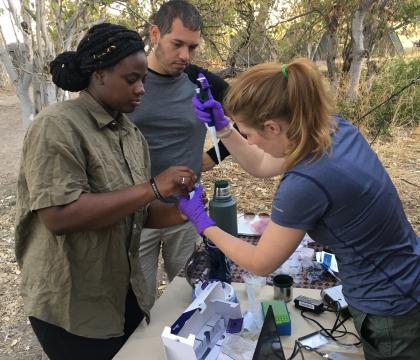
Experience the remarkable history and biodiversity of Rwanda through an immersive three-week field course in Akagera National Park – a real conservation success story. A cohort of learners from Stanford and Rwanda together will begin by exploring the vibrant capital city of Kigali through its art, food and culture, and then we will travel to Akagera where the team will camp. We will use hands-on techniques to study and monitor biodiversity in the field by camera-trapping, acoustic sensing and microscopic identification, and DNA extraction and sequencing of environmental samples. We will gather together daily to reflect on our experiences and examine ourselves in relation to each other and the planet.
Field sites
The course will be held in Akagera National Park, in the east of Rwanda. We will include time before and after in the capital city, Kigali, to explore historic sites and participate in Rwandan cultural activities, learning how and why Rwandans value their place in African ecosystems.
Academic Objective
Integrated learning at field stations provides high-impact, off-campus research experiences that build passionate intellectual communities. This course will allow a diverse group of undergraduate students from Stanford to join a group of African students to experience and explore biodiversity conservation in Rwanda and its interactions with its geographic, climatic, economic, historic, archaeological, political and land management contexts in a new ecosystem.
Students will conduct hands-on research projects guided by professors, graduate students, wildlife experts and from local intergenerational learning teams intended to help “sense” the biodiversity of these remarkable places —from cameras, to environmental DNA to acoustic monitoring. These tools all form part of a collaborative initiative at Stanford, ‘Out of the Box - Into the Cloud’, which aims to facilitate access to existing technologies for non-invasive biodiversity assessments and to create long-term monitoring projects for conservation and research in the Anthropocene.
In integrated learning teams with their African counterparts, students will actively contribute to this initiative by applying tools and skills in remote settings so that they are more practical for conservation. Ultimately students in the program will learn about the role that each of us play in the unraveling of Biodiversity in the Anthropocene and what tools can be used to “sense” biodiversity and the changing environment. They will communicate their new awareness and knowledge through a variety of media.
Learning objectives
- Students will be able to define and encapsulate the myriad global challenges of the Anthropocene.
- Students will be able to cite multiple examples about how human, cultural and biological diversity affects human survival, and how in turn, global issues affect diversity.
- Students will be able to compare and contrast forces of global change in Rwanda (i.e., land use change, climate change, biodiversity loss, poaching, pollution, population)
- Students will be able to measure biodiversity with an array of non-invasive survey tools and will be able to identify appropriate tools to measure biodiversity.
- Students will communicate a product or reflection of their experience through media of their choice, including but not limited to a written or oral synthesis, a photo or video essay, drawings and/or paintings.
Academic Content
Experimental design, data analysis and statistical design, biodiversity conservation, conservation genomics, cultural and geopolitical factors for conservation outcomes, and protected area management strategies.
Skills Component
Students will learn practical field-based research skills, including automated data capture and mapping techniques (ArcGIS QuickCapture), eDNA sample collection, DNA extraction, state-of-the-art sequencing and data analysis, PCR and DNA storage for export, iNaturalist documentation, bioacoustics recording, camera trapping, and science communication.
Instructors
The course will be led by HHMI Professor Elizabeth A. Hadly from the Department of Biology. Other instructors and teaching assistants may include:
Stanford University
- Anthony Barnosky, Professor of Biology & Director of Jasper Ridge Biological Preserve
- Gavin Sherlock, Professor of Genetics
- Manu Prakash, Associate Professor of BioEngineering
- Simon Morgan, Research Associate, Dept. of Biology and Jasper Ridge Biological Preserve
- Jordana Meyer, Graduate student, Dept. of Biology
African Parks
- Dr. Angela Gaylard, Head of Science Support
- Jes Gruner, Park Manager
- Drew Bantlin, Conservation Research
- Joseph Karama, Community Liaison Manager
Course Participants
10 Stanford undergraduate students will be selected from across all schools and 6 participants from African Parks ranger-staff and students.
Funding
The participation of Stanford students is supported by an HHMI grant, covering in-country travel and associated costs for Stanford students. Stanford students will purchase and arrange their own international flights and pay a $200 course fee to secure their spot on the course. Financial assistance towards the international flight and course fee may be available on a needs basis. To read more, scroll to the end of the page for "Cost and financial aid details".
Schedule
The Stanford participants will all arrive in time to meet the African team in Kigali on August 28th 2020 (time and place TBD). Course participants will acclimate in Kigali for three days. Here they will get to know one another and experience the culture and history of Rwanda.
The first full day the students are in Rwanda they will participate in Umuganda - translated as “coming together in common purpose to achieve an outcome,” a practice that has long existed in Rwandan culture but only recently became mandatory. All stores and businesses close for the first Saturday morning of each month, and community members come together to clean the streets, fix communal spaces and schools. They will also visit the Kigali Genocide Memorial, which is the final resting place for more than 250,000 of the 1 million victims of the Genocide against the Tutsi. Students will attend or interact with local universities to learn about education and conservation in Africa.
From here participants will travel to Akagera National Park (~4 hrs drive), where they will stay at Shakani Campsite for the next 12 nights, learning novel field research methods and collecting data for research projects.
A typical day will include an early morning start to head into the park to deploy sensors (audio devices, camera traps), collect environmental samples (soil, scat, water for eDNA studies) and complete observational studies (spoor transects, bird counts). Afternoons will typically involve further practical skill learning in camp (DNA extractions, image/audio processing), lectures, additional field trips and reflections.
Students will travel back to spend two more nights in Kigali where they will complete their projects, learn about science communication and outreach, and have time to reflect on their journey.
Academic Prerequisites
There is no requirement for a background in biology. However, students accepted on the course are expected to meet the program requirements listed in the Eligibility and Requirements section below.
Evaluation
- Project: Short paper on a biodiversity survey conducted (intro, methods, results, discussion).
- Outreach: Students can choose the media they prefer to discuss or reflect on the biodiversity surveys they conducted, encounters they made, or local issues that particularly touched them.
Grading Basis
Satisfactory/No Credit
Cost and financial aid details
The program fee for the 2020 overseas course in Rwanda is $200. The program fee covers room and board, transportation, course materials, and course activities for the duration of the program.
The program fee does not cover:
- International travel costs to and from the program location
- Visa costs ($30)
- Pre-departure immunization/vaccination costs
- International health insurance
- In-country cell phone costs
- Other incidental expenses (such as: laundry and souvenirs)
Some financial assistance towards the program fee may be available for students with demonstrated financial need as determined by the Financial Aid Office. Students will be notified regarding their eligibility for a fee waiver or a travel grant to use towards the cost of travel after they are accepted or waitlisted.
Eligibility will be determined by the Financial Aid Office. Students have until the withdrawal deadline (May 4, 2020) to withdraw without a financial penalty. Please contact the Financial Aid Office directly if you wish to discuss the possibility of taking out student loans to cover program costs.
Program Modification and Cancelation
Stanford reserves the right to cancel or modify the program before or during its operation for any reason, including natural disasters, emergencies, low enrollment, or unavailability of facilities or personnel or compliance with the University travel policy. The specific program dates, itineraries, locations, facilities, and activities are subject to change depending on available resources at the time, safety and security situations on the ground, and other important considerations that may arise for successful implementation of the program.
Students with Documented Disabilities
Students who may need an academic accommodation based on the impact of a disability must initiate the request with the Office of Accessible Education (OAE). Professional staff will evaluate the request, review appropriate medical documentation, recommend reasonable accommodations, and prepare an Accommodation Letter for faculty. The letter will indicate how long it is to be in effect. Students should contact the OAE as soon as possible since timely notice is needed to coordinate accommodations. Students should also send your accommodation letter to instructors as soon as possible. The OAE is located at 563 Salvatierra Walk (phone: 723-1066, URL: http://oae.stanford.edu).
About Rwanda and Our Teaching and Learning Partners
Significance of Rwanda and Akagera
In Africa, stories of success in relation to conservation efforts are unfortunately rare. In Rwanda students will be exposed to an organization and management strategy that has made this possible, and to a country and diverse culture which has made great progress in a short space of time.
African Parks - African Parks is a non-profit conservation organization, founded in 2000, that takes on the complete responsibility for the rehabilitation and long-term management of national parks and protected areas in partnership with governments and local communities. Their aim is to rehabilitate each park, making them ecologically, socially and financially sustainable long into the future. African Parks has 15 parks under management in nine countries, covering 13 million hectares (50,193 square miles) and representing seven of the 11 ecological biomes in Africa. This is the largest and most ecologically diverse amount of land under protection for any one NGO on the continent. African Parks will aim to select ranger- staff and or local students from the parks across their network to participate in the course.
Akagera National Park
About Akagera National Park: Akagera is almost unrecognisable today compared to just 20 years ago when it was on the verge of being lost forever. While peace was finally restored in the 1990s after the 1994 Genocide against Tutsis, Akagera’s demise was just beginning. Refugees returning to Rwanda after the genocide were still battling for their own survival and turned to the forests for timber, wildlife for protein and the wild savannahs for their livestock. Lions were hunted to local extinction, rhinos disappeared, and the park’s wildlife was displaced by tens of thousands of long-horned cattle. Biodiversity was practically lost, and with it so was employment and tourism. The park’s value was diminished to the point of not existing at all. Which makes where Akagera is today, with its story of revival, even more remarkable. In 2010, African Parks assumed management of Akagera in partnership with the Rwanda Development Board (RDB), shifting the park's trajectory from one of oblivion to prosperity and hope. After years of preparation, through effective law enforcement and management, 2017 saw the historic return of 18 Eastern black rhinoceros after a 10-year absence, thanks to the support from the Howard G. Buffett Foundation. Two new male lions were also translocated to Akagera in 2017 to enhance the genetic diversity of the growing pride, which has now tripled since their reintroduction in 2015. With poaching essentially halted, the park’s key wildlife populations have continued to rise. More than 44,000 tourists visited the park in 2018 alone, half of whom were Rwandan nationals, bringing in a record US$2 million in revenue and making the park 75% self-sustaining in just eight years.
Camping: Shakani offers a lakeshore camping experience along with noisy hippo and magnificent birdlife. Shakani is not fenced but has a low stone wall around it to deter hippos entering the campsite at night. Shakani has an ablution block with flushing toilets and solar-heated showers.
Health, safety and security conditions – The wildlife in the park are habituated to vehicles, and when out of the vehicle all course participants will be under the care of professional wildlife guides, and relevant precautions will be taken. There are Tsetse flies which can be a problem in certain parts of the park. While they have a nasty bite, they are generally harmless and no known cases of sleeping sickness have occurred in Akagera. Tsetse flies tend to be attracted to dark colors so participants are advised to wear khaki and lighter colors and make use of insect repellents.
Weather:
Dry season is June to September. There is very little rain during these months. Vegetation thins out and animals are attracted to the lakes and wetland areas in the park. Temperatures are warm and pleasant.
- June, July & August – Afternoon temperatures are usually around 27°C/81°F. Most days are sunny with a fine, clear sky. It gets cold at night, with minimum temperatures around 14°C/57°F. It’s usually cold in the early morning as well.
- September – Early September is still dry, but sometime this month the short rains might start. Temperatures remain the same.
Frequently Asked Questions
FAQs are attached as a PDF at the bottom of this page.
- Cultural and historical experiences in Kigali
- Join Rwandans in umuganda, translated as “coming together in common purpose to achieve an outcome” a monthly community action day
- Learn and use field-based research techniques in Akagera National Park to “sense” biodiversity, using cameras, environmental DNA, acoustic monitoring and other techniques
- Camp in Akagera National Park
- Learn with and from other learners from Africa who will be part of our cohort (10 Stanford and 6 African learners)
Eligibility / Academic Prerequisites
There is no requirement for a background in biology. However, students accepted on the course are required to:
- Attend the orientation for Stanford students and staff during Spring 2020 for safety and travel briefing.
- Attend the introductory session at Jasper Ridge Biological Preserve or via Zoom meeting in the month before travel (date TBD).
- Complete a one on one appointment with Vaden Travel Clinic.
- Meet with a doctor at the Vaden Health Center/Counseling and Psychological Services and submit a medical authorization form signed by Vaden.
- Obtain all required gear prior to the course. We will communicate complete gear requirements to course participants.
- Sign the Course Participation Agreement that will be issued to accepted students to hold their spot on the course. Students’ parents/families will also need to sign Ground Rules to confirm that they acknowledge the specific dangers of travel to the program location.