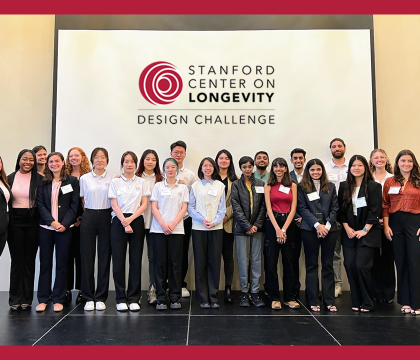
Stanford Center on Longevity Design Challenge 2024-2025
You are invited to participate in the Stanford Center on Longevity Design Challenge, a global innovation competition open to students at Stanford and universities around the world.
The 2024-2025 design theme is Reimagining Education and Learning for Long Lives:
To fully engage with our long lives, we must change our approach to learning and education. Rather than going to school for a fixed number of years when we're young, the Stanford Center on Longevity’s New Map of Life envisions learning new knowledge and skills throughout our lives, regardless of age.
The 2024-2025 Stanford Center on Longevity Design Challenge invites student designers to create solutions (e.g., physical products, digital solutions, community programs or services) that expand or rethink education and learning opportunities at any age, particularly those that close opportunity gaps and ensure equitable access to educational opportunities for all, regardless of socio-economic background or age.
- Create a design for a product, service, or program that addresses the Challenge theme, “Reimagining Education and Learning for Long Lives.”
- Submit your design online any time between September 9 and December 4, 2024: https://designchallengestanford.skild.com/
- 6-8 Finalist teams will be announced on January 29, 2025.
- Finalists will be awarded $1,000 USD and paired with an experienced mentor to help prepare for the finals.
- Finalists will present their design before a panel of judges at the finals in April. Grand prizes will be awarded (1st place: $10,000 USD, 2nd place: $5,000 USD, 3rd place: $2,000 USD).
- Students of all majors/fields of study are welcome to participate!
- Each team must consist of at least one full-time student.
- Teams may have a total of up to 5 members, and may also include students from other universities and/or non-students. Students may also compete alone, as a team of 1.
- Only students are allowed to present at the Finals.