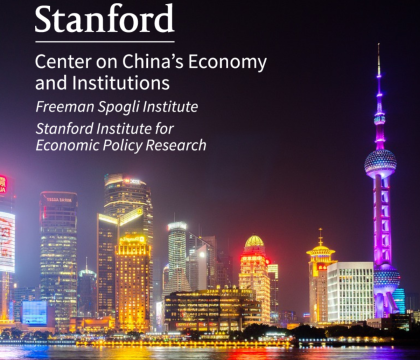
Understanding China’s Economy: SCCEI Summer Study Program 2026
The Stanford Center on China's Economy and Institutions (SCCEI) is Stanford’s home for empirical, multidisciplinary research on China’s economy. SCCEI aims to foster path-breaking research, create transformative student experiences, and advance public understanding of China’s economy and its impact on the world.
SCCEI is organizing a unique two-week program from Tuesday, June 16 to Saturday, June 27, 2026, that will enable students to delve deeply into China, the second-largest economy in the world. This intensive field excursion will involve different program modules -- including seminar sessions, workshops, and site visits -- to both internationally renowned companies in China and to the factory floor in a rural township.
Selected participants will gain a first-hand understanding of the complexities of China’s economy through site visits to technology firms, consumer markets, factory floors, education, healthcare, and environmental organizations. Participants will visit a spectrum of industries in Shanghai, Beijing, and an inland city (location TBD), and the ecosystem within which they operate. Under the close supervision of SCCEI’s faculty directors Hongbin Li and Scott Rozelle, participants will together explore the key issues, challenges, and opportunities that China faces as refracted through the experiences of these organizations.
Learning Objectives:
By the end of the two-week program, students will come away with a deeper understanding of China’s political economy, the factors that have contributed to its rise, elements that may fuel or hinder its continued growth, and the geopolitical context that confronts the country and its economy. More specifically:
-
Students will come away with a deeper understanding of some of the major sectors and companies in China and the ecosystem in which they operate;
-
The key challenges and opportunities facing these organizations and the means by which these entities are navigating their political, economic, social, and international contexts;
-
The program will also provide a unique window onto a critical bilateral relationship of the 21st century - that between the United States and China.
This two-week, immersive program will include a carefully selected itinerary of visits to technology companies, retail markets, universities, and factory plants in both urban and rural China, including Shanghai, Beijing, and an inland city (exact location still TBD). While the program is open to all currently enrolled Stanford undergraduate and co-terms, freshmen and sophomores are given priority if everything else is equal. This is an intense field excursion and will require full commitment during this period. During the program, selected students will:
-
Visit China’s leading technology companies and businesses in Shanghai and Beijing, and small businesses operating on these platforms from rural areas. Students will be asked to probe the factors driving China’s economic growth and to think critically about its complexity and challenges
-
Visit schools in both urban and rural cities to understand China’s education system, and how human capital will affect the country’s labor force and China’s future growth
-
Connect with Stanford alumni in China, faculty from Peking University, and friends at the Stanford Center at Peking University to learn from their experiences, create connections, and open doors to future collaborations.
Locations: Shanghai, Beijing, and an inland city (TBD)
Faculty Mentors: SCCEI’s faculty directors Hongbin Li and Scott Rozelle
Application Requirements
-
Submit an online application form through SOLO
-
Curriculum Vitae or Resume
-
Unofficial Transcript
All applications will be due by Sunday, January 25, 2026, at 11:59pm. Complete applications will be screened, finalists interviewed by the program committee (target week of Feb 23). We plan to release a decision before the final week of the winter quarter. Applicants should respond promptly via email to the program offer, or the offer will be rescinded. The 2026 cohort will be formed before the spring break.
Candidates who demonstrate the ability to integrate the program’s experience with their own academic interests, research, and career goals will be preferred. The purpose of this immersive program is to expand a participant’s understanding of contemporary China, its economic system, and its political context.
Program Costs:
Students are financially responsible for:
-
Pre-departure immunizations
-
Travel medicine consultations
-
Health insurance (with sufficient coverage for the duration of your time abroad as required by the program, including coverage for medical care and treatment outside the U.S., medical evacuation, and repatriation of remains)
-
Visa costs
-
International Airfare
-
All other incidental expenses
Program will cover:
-
In-country accommodation and transportation
-
Most of the meals, except for a few free nights
For participants with demonstrated financial need, we will provide a stipend sufficient to cover international travel expenses, including visa fees and round-trip economy-class airfare, based on fares to and from San Francisco. For admitted students, financial need will be verified through their Stanford financial aid status or by submitting documentation of need, such as proof of an applicable scholarship.
Required:
- Program participants must attend all orientation meetings, complete a final narrative report after the program, and participate in a public presentation as instructed by the program leadership.
- Program participants must also complete an Office of International Affairs (OIA) international travel preparation course via Canvas and a Vaden Travel Health information session or a travel clinic appointment during the spring quarter.
- Program participants must certify that they are in good academic standing and may not participate in the program or receive or retain program stipends if they are on suspension.
Desired:
- Enthusiasm for learning, teamwork, maturity, and cultural sensitivity.
- Prior demonstrated interest or involvement in China or East Asian affairs, including related coursework, will enhance your application but is not required.
- Students enrolled in Econ 131: “The Chinese Economy” with Professor Hongbin Li and Professor Scott Rozelle will be given preference for this program. Enrollment in Econ 131 is not a prerequisite, however.
- Mandarin Chinese is helpful but not required.
General Guidelines:
- All majors are welcome.
- The program is open to all undergraduate students. Seniors or co-terms are eligible as long as they do not confer their undergraduate degrees until after they complete their summer program in order to remain eligible. Coterm students must still have undergraduate status.
- Students must be enrolled full-time at Stanford in undergraduate study in the quarter when they apply (Winter), and when the stipend is disbursed (Spring).
- Violations of the program policies will also be considered violations of the Fundamental Standard and may be referred to the Office of Community Standards. Students who fail to abide by the policies set forth by SCCEI, this program, and Stanford University will have low priority or no longer be eligible for future SCCEI funding opportunities and programs. SCCEI reserves the right to rescind funding at any given point and time should they be apprised of any policy violations as outlined above.
Travel Requirements:
- Policies regarding travel (domestic or international) will be updated as University policies evolve. Visit International Affairs Travel Advisories for the most current travel guidance and restrictions for international travel.
- International students must consult with Bechtel about traveling out of the U.S. during the summer.
- Travel Reservations: All participants are required to utilize Stanford Travel, a centralized booking program, when booking airfare for this program. StudentUniverse is best for special student rates.
- To be eligible for the program/travel stipend, students must maintain health insurance for the duration of this program.
- Currently, according to travel advisories, China’s overall risk is rated as “low” though it is important to be aware that there is no presumption of privacy in China. To review detailed location intelligence, log in to the Crisis24 Horizon Platform.
- All individuals engaging in university-sponsored travel must comply with all applicable travel policies. Please note that Stanford reserves the right to cancel or modify the program before or during its operation for any reason, including but not limited to natural disasters, emergencies, or compliance with the University travel policy.