Food Security Fellowship with Valley Verde, Summer 2026
OVERVIEW
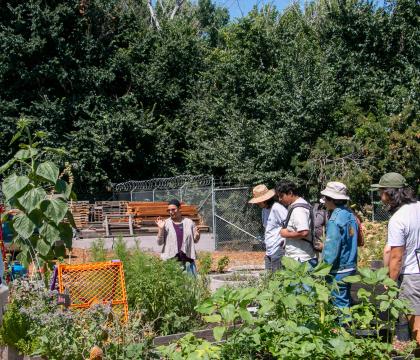
Valley Verde is a nonprofit organization in San José that promotes food security, self-reliance, and sovereignty through urban gardening education and resources. Our programs teach gardening, composting, beekeeping, and business entrepreneurship. We also operate a nursery that grows more than 80 culturally-relevant seedling varieties. Valley Verde is seeking a fellow who is passionate about food security, sustainability, community science, curriculum development, and community engagement.
PREFERRED QUALIFICATIONS
- Experience working in a multi-ethnic community environment and have multi-cultural literacy.
- Ability to develop professional relationships with program participants regardless of language barriers, cultural differences, or physical/mental abilities.
- Knowledge of gardening, food justice, and environmental topics.
- Written and verbal skills in Spanish or Vietnamese.
- Skills in community science, curriculum development, and community engagement.
POSSIBLE PROJECTS
Valley Verde is seeking a fellow to support two or more of the following projects:
Community science for gauging community needs
We are starting to practice community science to better understand the dynamic and growing food-related needs of our community. We will use focus groups, interviews, and surveys to gather information from our community members. We need help recruiting participants, data entry and analysis, research, system mapping, report writing, and sharing findings widely. The project will improve the effectiveness of the nonprofit community and government agencies in serving Santa Clara County’s food-insecure.
Community science for food system transformation
We are starting to practice community science to understand better the state of California’s food system’s transformation toward sustainability. We need help identifying key events that comprise existing trends, performing data entry, conducting quality control, and writing case studies. The project will improve the effectiveness of the nonprofit community and government agencies in transforming Santa Clara County’s food system toward sustainability.
Gardening curriculum for elementary schools
Our Shared Garden Program teaches adults the skills they need to start growing and nurturing their own home garden. Among these adults are parents of elementary school children who want their children to learn gardening as well. We currently have a curriculum for children that aligns with the Shared Garden Program’s Spring curriculum. We need help developing a Fall curriculum for children. The project helps families in our community take steps together toward greater food sovereignty.
Gardening curriculum for middle and high schools
Our Deep Roots Program helps adults take their gardening skills to the intermediate level. Among these adults are parents of middle- and high-school adolescents who want their children to learn gardening as well. We need help adapting the Program’s curriculum for middle and high school students. The project helps families in our community take steps together toward greater food sovereignty.
Scan inventory system for nursery
Our Homeland Nursery grows over 80 different varieties of seedlings not commonly found in grocery stores (okra, bittermelon, heirloom corn, hot habanero pepper, etc). It grows seedlings for our Shared Garden and Deep Roots Programs and offers the rest for sale to anyone interested in growing their own culturally relevant food that supports their diet and tradition. Currently, we enter all seedling inventory data by hand, which takes a lot of time. We need help developing a scan-based inventory system. The project helps us become more effective and allocate our time more efficiently.
Social media strategy
Valley Verde has a presence on Facebook, Instagram, and LinkedIn, where we post weekly about events and garden-related topics. We need help developing a measurable, seasonally tailored social media strategy that boosts our seedling sales and builds relationships with program participants, volunteers, and funders/donors. The project helps us develop our brand and become more effective and financially secure.
Program Details
PCJ in the Bay fellowships are Cardinal Quarter opportunities through the Haas Center for Public Service. This is a full-time (35-40 hours/week), 10-week opportunity during Summer 2026, starting no later than July 6, 2026. Doctoral students with a 50% summer assistantship may be eligible to work part-time (16 hours/week). All fellows are required to work with their community partners for ten consecutive weeks.
Please note that students can apply for no more than three different PCJ fellowship opportunities during a single application round.
Eligibility & Requirements
Please review our program policies for complete eligibility requirements.
Undergraduates of all academic disciplines are encouraged to apply. Priority will be given to students who have completed fewer than two previous Cardinal Quarter opportunities.
In order to be eligible for a Haas Center-sponsored Cardinal Quarter summer opportunity, undergraduate students are required to be enrolled in both the winter and spring quarters. Graduate level students must be enrolled at least in spring quarter.
Students are required to be in good academic standing. The requirements for good academic standing include: 1) Earn at least 9 units of credit in a single quarter. 2) Earn at least 36 units over the most recent three quarters 3) Maintain a cumulative grade point average (GPA) of 2.0 or above.
Additional Fellowship Requirements
This opportunity is associated with Partnerships for Climate Justice in the Bay Area (PCJ in the Bay), an initiative to build equitable climate change solutions by supporting partnerships between Stanford students, faculty and Bay Area community leaders. Fellows will be a part of a cohort of other PCJ in the Bay summer fellows placed at sites across the Bay Area.
Additional requirements include
Spring 2026:
- Complete a pre-program assessment survey.
- Attend the spring retreat with cohort peers (date TBD).
- Complete an online program orientation.
- Participate in an in-person Principles of Ethical and Effective Service workshop at the Haas Center.
- Identify and meet with an academic mentor (Stanford faculty or staff) at least once.
- Design a personal learning plan and share the learning plan with your site supervisor and academic mentor.
- Complete all required pre-orientation forms.
Summer 2026:
- Attend all PCJ in the Bay Fellows cohort activities (more information will be shared about these events in spring quarter).
- Submit a final report documenting your work and a reflection on your learning.
- Correspond with fellowship donor(s) as requested by fellowships program staff.
- Complete a post-program assessment survey.
Fall 2026:
- Meet with your academic mentor to discuss your fellowship experience at least once.
- Participate in outreach activities to share the experience and help publicize the program.
Stipend Information
Undergraduate Cardinal Quarter Fellows receive a base stipend of $8,000 (which includes a $500 cost of living adjustment for the Bay Area) to support living expenses during the 10-week fellowship. Financial aid and supplemental funding ($1,000-$1,500 additional) may be available to students who qualify (learn more here).
Students in a 2-year Masters program will receive a stipend of $9,500. Students who have begun their coterm programs (i.e., paying graduate tuition) will also receive a stipend of $9,500. Doctoral students on a 50% assistantship can work up to 16 hours/week and will receive up to $4,500 for a part-time fellowship. Doctoral students without a summer assistantship can work full-time and will receive a stipend of $11,000.
Selection Process
Complete applications are screened, finalists interviewed, and fellows selected by the host organizations staff with the intention to award fellowships prior to spring break. Applicants should respond promptly (within 48 hours) via email to a fellowship offer, or the offer will be rescinded. Once an applicant accepts a fellowship offer, the student should promptly notify all other Stanford and non-Stanford programs to which they have applied that they have accepted another offer and to withdraw their candidacy.
Frequently Asked Questions for PCJ Summer 2026 Fellowships