Just Transition Research Fellowship with Communities for a Better Environment, Summer 2026
Overview
The world of oil refining is coming to an end, but there is no guarantee that the transition away from fossil fuels will be just. In recent years, oil companies have gone bankrupt and left land toxic and polluted, overnight refinery shutdowns have led to widespread layoffs, and unsafe equipment practices have caused dangerous explosions. Meanwhile, oil companies have turned to False Solutions like biofuels and dirty Hydrogen to extend the lifespan of their aging infrastructure and prevent a real transition to clean energy sources. All of these Unjust Transitions protect corporate profits while abandoning the workers and communities that have borne the impacts of these industries for generations – especially the low-income Black and brown communities where industrial polluters tend to be located.
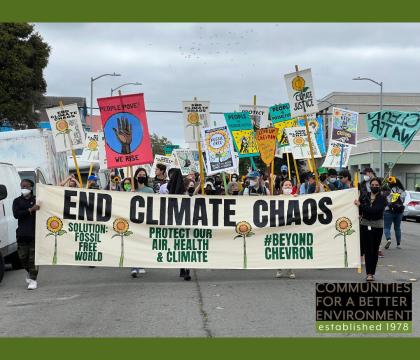
Communities for a Better Environment (CBE) is fighting for a Just Transition in Richmond, where the massive Chevron Refinery has polluted Richmond’s air, land, water and politics for over a century. This Just Transition means moving away from the current, extractive economy in which Chevron and other large polluters play an outsized role, towards a regenerative economy in which workers, the community, and the environment are supported. Making this transition a reality requires deep community planning and visioning, and research will play a key role in facilitating this process.
This fellowship will support Communities for a Better Environment in conducting research to support their campaign for a Just Transition in Richmond. As with all of CBE’s research, this project will support ongoing community organizing and legal advocacy. The primary goal will be to develop useful tools and resources that are genuinely impactful for the Richmond community.
About the Fellowship
The fellow will work with CBE to support its Just Transition research. Projects will be designed based on the skill sets of applicants. However, the following are examples of what Just Transition research may focus on:
- Air, soil, and water contamination due to refinery activity
- Mapping health disparities across neighborhoods in Richmond
- The labor and economic impacts of a transition away from oil refining
- Community based participatory research, including participatory science, to hold Big Polluters accountable (in collaboration with adult and youth members)
- “Building the New” solutions towards just and sustainable world free from fossil fuels
- Global harms of local Polluters (e.g., Chevron’s deforestation in the Amazon, energy apartheid in Palestine)
The fellow may be asked to contribute to the following:
- Support member-driven, community-based research on refinery impacts and a transition away from fossil fuels
- Present and/or facilitate workshops for community members on Just Transition-related topics, such as through contributing to our “Build the New” member series
- Design and draft creative research outputs such as infographics, zines, art projects, blog posts, and online StoryMaps
- Conduct economic, financial, and/or qualitative analysis of labor questions in a Just Transition, including the potential to interview workers and union members
- Engage/collaborate with youth members on youth-driven participatory action research (YPAR)
- Create approachable educational resources and guides for community members on topics such as mutual aid and Resilience Centers
Preferred qualifications:
Just Transition research requires a range of skills and expertise. Advanced undergraduates and graduate students (Masters or PhD-level) in the fields of Earth Systems, Public Health, Public Policy, Urban Studies, and Comparative Studies in Race & Ethnicity are particularly encouraged to apply, but students from other fields will also be considered. All applicants should bring a passion for social and environmental justice, and excellent research and communication skills.
Program Details
PCJ in the Bay fellowships are Cardinal Quarter opportunities through the Haas Center for Public Service. This is a full-time (35-40 hours/week), 10-week opportunity during Summer 2026, starting no later than July 6, 2026. Doctoral students with a 50% summer assistantship may be eligible to work part-time (16 hours/week). All fellows are required to work with their community partners for ten consecutive weeks.
Please note that students can apply for no more than three different PCJ fellowship opportunities during a single application round.
Eligibility & Requirements
Please review our program policies for complete eligibility requirements.
Undergraduates of all academic disciplines are encouraged to apply. Priority will be given to students who have completed fewer than two previous Cardinal Quarter opportunities.
In order to be eligible for a Haas Center-sponsored Cardinal Quarter summer opportunity, undergraduate students are required to be enrolled in both the winter and spring quarters. Graduate level students must be enrolled at least in spring quarter.
Students are required to be in good academic standing. The requirements for good academic standing include: 1) Earn at least 9 units of credit in a single quarter. 2) Earn at least 36 units over the most recent three quarters 3) Maintain a cumulative grade point average (GPA) of 2.0 or above.
Additional Fellowship Requirements
This opportunity is associated with Partnerships for Climate Justice in the Bay Area (PCJ in the Bay), an initiative to build equitable climate change solutions by supporting partnerships between Stanford students, faculty and Bay Area community leaders. Fellows will be a part of a cohort of other PCJ in the Bay summer fellows placed at sites across the Bay Area.
Additional requirements include
Spring 2026:
- Complete a pre-program assessment survey.
- Attend the spring retreat with cohort peers (date TBD).
- Complete an online program orientation.
- Participate in an in-person Principles of Ethical and Effective Service workshop at the Haas Center.
- Identify and meet with an academic mentor (Stanford faculty or staff) at least once.
- Design a personal learning plan and share the learning plan with your site supervisor and academic mentor.
- Complete all required pre-orientation forms.
Summer 2026:
- Attend all PCJ in the Bay Fellows cohort activities (more information will be shared about these events in spring quarter).
- Submit a final report documenting your work and a reflection on your learning.
- Correspond with fellowship donor(s) as requested by fellowships program staff.
- Complete a post-program assessment survey.
Fall 2026:
- Meet with your academic mentor to discuss your fellowship experience at least once.
- Participate in outreach activities to share the experience and help publicize the program.
Stipend Information
Undergraduate Cardinal Quarter Fellows receive a base stipend of $8,000 (which includes a $500 cost of living adjustment for the Bay Area) to support living expenses during the 10-week fellowship. Financial aid and supplemental funding ($1,000-$1,500 additional) may be available to students who qualify (learn more here).
Students in a 2-year Masters program will receive a stipend of $9,500. Students who have begun their coterm programs (i.e., paying graduate tuition) will also receive a stipend of $9,500. Doctoral students on a 50% assistantship can work up to 16 hours/week and will receive up to $4,500 for a part-time fellowship. Doctoral students without a summer assistantship can work full-time and will receive a stipend of $11,000.
Selection Process
Complete applications are screened, finalists interviewed, and fellows selected by the host organizations staff with the intention to award fellowships prior to spring break. Applicants should respond promptly (within 48 hours) via email to a fellowship offer, or the offer will be rescinded. Once an applicant accepts a fellowship offer, the student should promptly notify all other Stanford and non-Stanford programs to which they have applied that they have accepted another offer and to withdraw their candidacy.
Frequently Asked Questions for PCJ Summer 2026 Fellowships